
DISCOVERY OF THE 12 MERIDIANS OF ACUPUNCTURE
What do they do and what do they mean for your health?
Welcome to the highway of your Qi.
The transport system of your vital energy throughout the body and organs...
… and the core of Chinese medicine and acupuncture.
Essentially, meridians form a system through which energy circulates, much like blood circulates through the body.
The difference is that instead of blood, vital energy called Qi (pronounced "Chi") flows through the meridians.
It is at the same time simple and very complex. There are several concepts associated with the whole system and we will delve into their meaning on Frequency-Therapy-Healing.com.
For example, to describe the direction of energy flow, the Meridian system includes the duality of Yin and Yang. Yin energy radiates outward, while Yang energy returns to the core.
Another concept involving flow is the Chinese term for meridians, Jing Luo. Jing means "through". It refers to the vertical passages along the meridian. Luo refers to connecting tributaries. Together we call them the "channel network".
According to Chinese medicine, the human body has 12 main meridians:
What is the significance of the 12 meridians? All 12 follow a chronological sequence. Each is most active at certain hours of the day or night; Chinese medicine associates those hours with the activity of the corresponding organ. The pattern resembles the ebb and flow of the tides: each meridian has its own peak period, when the flow of energy and blood is considered strongest. The article therefore recommends supporting different organs at their respective times, with the idea that half the effort may bring twice the result. This is the basic relationship between meridians, organs and time.
Energy or qi/chi circulates through the meridians in the body, which keeps you healthy. If circulation is interrupted, disease occurs. According to traditional Chinese medicine, pressing acupuncture points can remove blockages on individual meridians.
The meridian clock is a very useful tool to help with energy imbalances. With meridian frequencies, you can improve the activity on an individual meridian during certain hours.
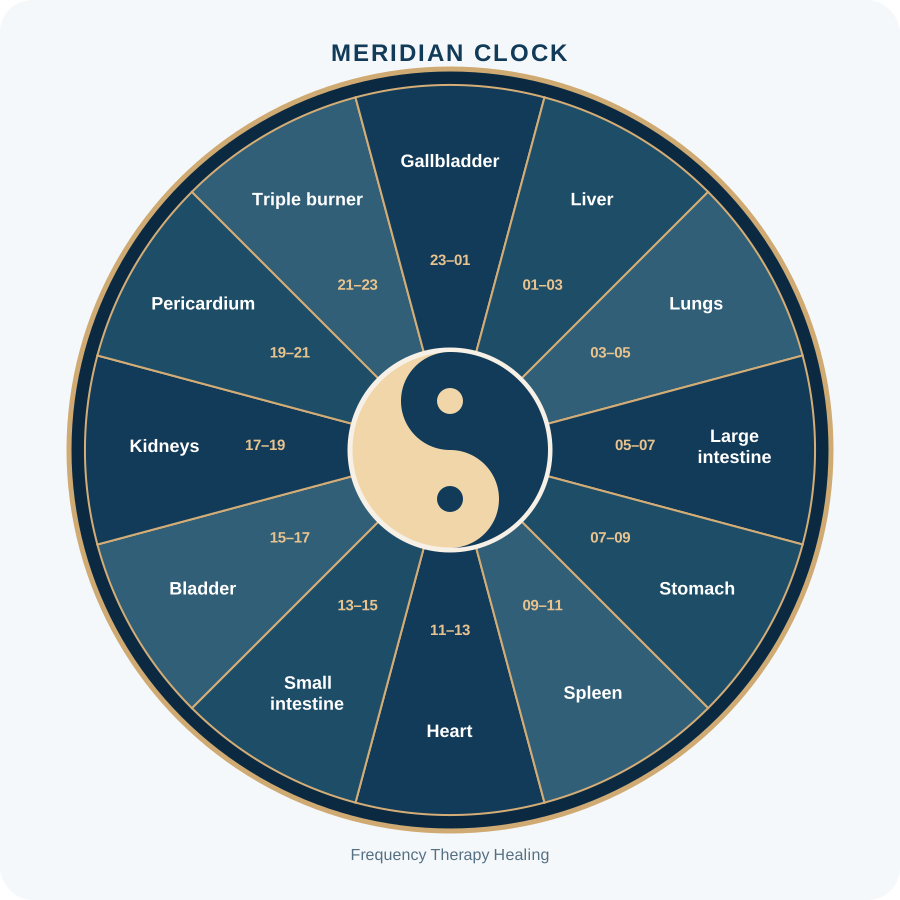
Below, see pictures of meridians and their frequencies.
Alongside the hours when each meridian is most active, the frequencies that can be entered into a Zapper are listed here (and in the meridian table). Treatments for each meridian can be carried out with handheld electrodes; conductive gloves can make them even more effective. Because the gloves conduct both inside and out, you can stimulate each meridian through massage…
The twelve main meridians
Heart 289 Hz (11:00–13:00)
The heart pushes the blood to flow and lift the spirit. Taking a nap during this period is good for lifting spirits and boosting energy.
"The king of organs" - the heart - is the house or the essence of vitality. It commands all other organs and emotions. The heart is also the seat of our mind. It works with many organs to regulate circulation and maintain a healthy mental state. If the heart is unbalanced, all other organs and meridians will suffer. The heart is primary in defense against disease.
The tongue is used in diagnosing heart imbalances. Speech errors or muteness are considered to be due to an imbalance on the heart meridian. As a source of body heat and blood circulation, a pale complexion can indicate imbalances on the heart meridian.
All kinds of mental and emotional problems can have their cause in an imbalance of the heart meridian.
The heart meridian begins near the armpit, runs along the inner side of the arm and ends at the tip of the little finger.

Small intestine 316 Hz (13:00–15:00)
The small intestine adjusts the diet of the day.
The small intestine, responsible for receiving food during digestion, is known as the 'minister of reception'. It separates impurities from food and absorbs water before transferring waste.
It should come as no surprise that the small intestine meridian is responsible for digestion. However, this meridian works in tandem with the heart meridian.
It controls the basic emotions and the Chinese synonym for "broken heart" is "broken gut". The meridian also works with the pituitary gland, which is known as the "master gland" for regulating growth and the endocrine system.
An imbalance in the small intestine meridian can cause weight loss and abdominal pain. It can also lead to restlessness and impaired thinking.
From the tip of the little finger, the small intestine meridian rises along the back of the arm. It zigzags across the back of the shoulder, then ascends along the side of the neck. On the cheek it turns outward and ends in front of the ear.

Bladder 343.8 Hz (15:00–17:00)
Correct activities improve the circulation of body fluids.
The bladder is called the "reservoir minister". While the organ itself merely stores and removes liquid waste, its energetic function includes balancing the autonomic nervous system. This is partly because the bladder meridian spans the entire height of the body and runs along the spine. The bladder plays an important role in regulating the sympathetic and parasympathetic nervous systems.
An imbalance of the bladder meridian can cause low back pain or weakness in the low back and difficulty urinating. An imbalance of this meridian can also cause fear or stubbornness.
The Bladder Meridian begins at the inner part of the eye and runs up the skull where it turns outward before descending down the back. The meridian then follows the hip and sacral nerves before running down the back of the leg and ending on the outside of the little toe.
Note: enter a frequency of 344 Hz in the Zapper.

Kidneys 383.7 Hz (17:00–19:00)
The kidneys begin to store essence. This time is not suitable for too much movement or a lot of water.
In traditional Chinese medicine, the kidneys are among the most important organs. This organ includes the adrenal glands and the male and female sex organs. The kidneys are known as the "minister of strength" and also the "root of life". Their task is to store prenatal energy, as well as essential life energy. The kidneys work in regulating the brain and play an important role in the formation of memories and rational thinking.
An imbalance in the kidneys can cause impotence or immunodeficiency. It can also lead to poor memory or an inability to think clearly. The diagnosis of kidney meridian imbalance is made by examining the eyes and hearing. Back pain and short-term attention span can also be indicators of kidney meridian imbalance.
The kidney meridian begins on the sole of the foot and follows its inner edge before circling the ankle. It rises along the inner leg and continues up the middle of the torso, ending near the inner end of the collarbone.
Note: enter a frequency of 384 Hz in the Zapper.

Pericardium 477 Hz (19:00–21:00)
Make sure you are in a good mood during this time. You can read a book, listen to music, go to the SPA, dance or play Tai Chi to relax and neutralize stress.
Although the pericardium is not an organ, it corresponds to an actual part of the body. The pericardium is the protective sac surrounding the heart. Its functions also support the triple burner meridian. It is one of two principal meridians not associated with a major organ. Its protective role extends beyond the physical to the mental, emotional and spiritual.
It is also responsible for regulating blood circulation. The pericardium meridian connects feelings of love with physical sex.
Imbalances can cause problems with the heart, chest, stomach and mind. Imbalances in this meridian are often the result of extreme, sustained outbursts of emotion.
The pericardium meridian begins in the centre of the chest and descends to the diaphragm. It also branches from the chest, travels along the inner arm and ends at the tip of the middle finger.

Triple burner 496 Hz (21:00–23:00)
If a person sleeps during this time, he can get the best rest, which is very beneficial for the body.
The triple burner meridian is the second primary meridian not associated with an organ. It resembles the thyroid in its role in regulating metabolism, though its role is not limited to energy metabolism. It also participates in digestion and the processing of waste.
As its name suggests, the triple burner has three parts: upper, middle and lower. The upper burner extends from the base of the tongue to the stomach and governs the intake of food, water and oxygen. The middle burner begins at the stomach and ends at the pyloric sphincter, or valve. It is responsible for digesting and transforming nutrients for the body to use. The lower burner then branches and ends at the anus and urinary tract. Its task is to remove waste.
When there is an imbalance, there can be disturbances in the sense organs and the side of the head.
The triple burner meridian begins at the tip of the ring finger. It ascends along the back of the arm, crosses the shoulder and ends at the collarbone.

Gallbladder 506.8 Hz (23:00–01:00)
When a person falls asleep during this time, the gallbladder can complete metabolism. Poor bile acid metabolism leads to the formation of gallstones.
The gallbladder meridian is portrayed as the body’s caretaker. This is not meant as an insult: the ancient Chinese called it the “Honorable Minister”. The gallbladder secretes bile to aid digestion, thereby providing energy to the muscles. It works with the lymphatic system to eliminate lactic acid. In this account, the gallbladder meridian therefore plays a part in muscle health.
The gallbladder meridian is responsible for bold and decisive mental states. The aphorism "a lot of bile" reflects this belief in ancient Western cultures as well.
An imbalance on the gallbladder meridian causes more mental than physical distress. Such an imbalance also leads to insomnia and muscle stiffness. It can cause poor judgment, timidity and indecisiveness.
The Gallbladder Meridian begins at the outer corner of the eye. It zigzags up and down in front of the ear and above the eye before running down the back of the skull. It goes down the side of the body, continues along the outside of the leg, and ends at the outer edge of the 4th toe.
Note: enter a frequency of 507 Hz in the Zapper.

Liver 1032 Hz (01:00–03:00)
During this time, the human body needs a lot of oxygen, which requires deep sleep.
The liver is considered one of the main organs in traditional Chinese medicine. It is called the “Chief of Staff” within the body’s headquarters.
This is partly because the liver turns nutrients into usable substances that the body uses for energy. The liver also detoxifies the blood.
The liver meridian is responsible for the peripheral nervous system, ligaments and tendons. An imbalance in the liver meridian causes hypertension and difficulty relaxing. Liver imbalances are diagnosed by examining the eyes and the fingernails and toenails. An imbalance in this meridian can also cause problems with anger.
The liver meridian begins on the inner side of the big toe. It crosses the instep and ascends the inner leg. At the hip, it descends towards the genitals before rising again. In the lower abdomen it turns upwards towards the ribs, then returns towards the middle of the torso and rises to its endpoint at the nipple.

Lungs 2287 Hz (03:00–05:00)
The liver supplies fresh blood to the lungs, and the fresh blood is sent to the body through the lungs. This is why people feel energetic in the morning.
The lung meridian is second only to the heart meridian in importance among the 12 main meridians. It is also called the "prime minister" and helps control energy and blood circulation. The lungs and heart work in conjunction with blood and energy and are complementary parts of the living system. This connection is the reason why the lungs are also called "priest" and "heavenly minister". The lungs also control the skin and perspiration.
The lung meridian creates so-called radiant energy. This control puts the lungs at the fore in the fight against external diseases. The lungs connect the mind and body through breathing. Qigong is designed to strengthen this connection, so it focuses on the lung meridian.
Lung meridian imbalances can cause upper respiratory infections, breathing disorders, and skin problems. An imbalance can also cause despair and anxiety.
The lung meridian begins at the front of the shoulder. It first rises, then descends along the arm and ends at the tip of the thumb.

Large intestine 4230 Hz (05:00–07:00)
The lungs fill the body with enough fresh blood to speed up the action of the large intestine, allowing it to complete the process of water and nutrient absorption and defecation.
The large intestine is responsible for forming solid waste from liquid. Known as the “master transporter”, it is the last organ before solid waste is eliminated. The large intestine works more closely with its counterpart (the lung) than most. The lungs move the colon through breathing. The colon regulates body fluids, working together with the lungs.
An imbalance on the colon meridian can cause constipation, diarrhea, and abdominal pain. An imbalance of this meridian also results in depression and excessive anxiety.
The large intestine meridian begins on the outer side of the index finger. It travels up the arm, passes behind the shoulder, crosses it and runs along the throat before ending just below the nose.

Stomach 126.9 Hz (07:00–09:00)
During this time, breakfast is easy to digest and absorb.
The stomach is responsible for elemental balance. Called the “Sea of Nutrition” and the “Minister of Grinding”, it marks the beginning of digestion. Because of the umbilical cord, it is also called the “Root of Postnatal Life”. The stomach is responsible for extracting energy from food and drink.
Together with the spleen, the stomach transmits energy through the meridian system. The stomach also uses the different types of food eaten to balance the five basic energies.
An imbalance on the stomach meridian causes energy deficiencies in the meridian system. Imbalances can also cause mania, confusion, or anxiety.
The stomach meridian starts below the eye, next to the nose. It descends before following the jaw to the skull. It then falls and runs down the throat, chest and stomach. It continues down the front of the legs and feet before ending at the outer edge of the big toe.
Note: enter a frequency of 127 Hz in the Zapper.

Spleen 264.9 Hz (09:00–11:00)
The spleen regulates digestion, absorption and excretion, and has powerful filtration and blood storage functions.
This meridian also includes the pancreas and is partly responsible for digestion. The spleen meridian is called the "minister of the granary". Enzymes produced in the spleen and pancreas are needed to absorb nutrients from food and drink. The spleen meridian regulates the quantity and quality of blood in circulation.
The Spleen Meridian works with the Lung Meridian to create true human energy. Muscle tone affects this meridian. The spleen meridian is responsible for logical and analytical thinking. It is also the first meridian in memory formation.
Imbalances in the spleen meridian can be diagnosed through the mouth. Red, moist lips indicate an excess of spleen energy, while pale, dry lips indicate the opposite. Bad mood and moodiness are associated with an imbalance of the spleen meridian.
The spleen meridian starts at the end of the big toe and travels up the inside of the leg. It moves in and out of the stomach until it travels up the body and ends under the front of the shoulder.
Note: enter a frequency of 265 Hz in the Zapper.

Du Mai Meridian (Governing Vessel)
Although not one of the 12 main meridians, it is often used in acupuncture. Dubbed the “Sea of Yang Meridians”, Du Mai controls the Yang meridians. It also controls the “Guardian Qi” and both are related to the immune system and the ability to fight external diseases. Also, this meridian is the "fire" of the body and is responsible for body heat.
Du Mai also works with the kidneys to regulate the brain. Along with the Ren Mai meridian, it is one of the most important meridians in traditional Chinese medicine.
Du Mai begins at the pelvic floor and travels up the back, over the top of the head, and ends above the upper lip.
Du Mai has 28 acupuncture points.
Ren Mai (Conception Vessel)
Like Du Mai, Ren Mai is not one of the 12 main meridians. Nevertheless, the Ren Mai meridian is widely used in acupuncture. It is also known as the “Sea of Yin Meridians”. It receives Qi from the Yin meridians before distributing it to the Yang meridians. Ren Mai is responsible for the circulation of Qi throughout the body. It also controls the reproductive cycle and libido.
Ren Mai helps regulate the 7-year life cycle. It also creates and regulates “Guardian Qi”. Along with Du Mai, it is one of the two most important meridians in traditional Chinese medicine.
Ren Mai begins at the base of the pelvis and travels along the front of the body to the lower lip. It is one of the main meridians in Qigong practice.
Ren Mai has 24 acupuncture points.
Scientists have found that meridian points provide a good electrical pathway to the target organ. Using the frequencies on the meridians improves the results. With Zappers, which have the possibility of programming with different frequencies, you can easily stimulate your meridians.
Source of information and images about meridian frequencies is Spooky2.